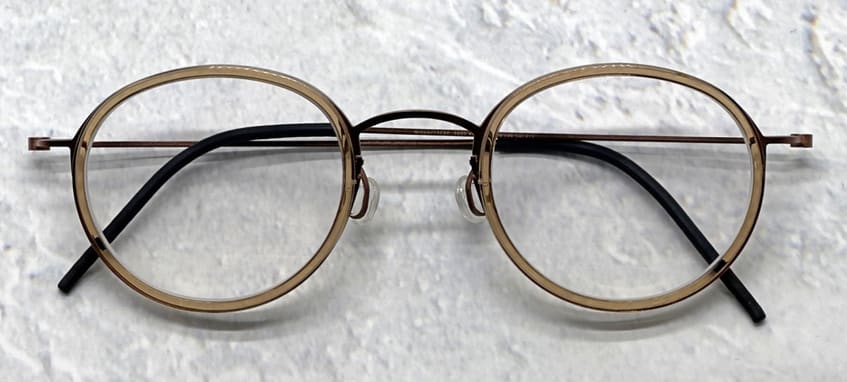
If you have spent any time researching luxury eyewear, you have encountered this question: MYKITA or Lindberg? Both brands are German-Scandinavian engineering at its finest. Both use screwless construction. Both weigh almost nothing. Both are made by people who find conventional eyewear philosophically unsatisfying. And yet they are profoundly different — in philosophy, in aesthetic, and in who they are right for.
Start with the construction. Lindberg's signature is strip titanium: ultra-thin sheets of aerospace-grade titanium precision-cut and bent into shape without welding, soldering, or any fastener. The result is a frame that weighs as little as 1.9 grams — lighter than a paperclip. The construction is Danish minimalism made physical: every element is structural, nothing is decorative, and the frame disappears on your face. MYKITA's signature is their patented spiral hinge: a single sheet of stainless steel cut and hand-bent into shape, with temples that connect via a spring-loaded snap mechanism. No screws, no welds — but a different kind of engineering, one that prioritizes flex and resilience alongside lightness.
The aesthetic difference follows from the construction. Lindberg frames are quiet. They are designed to be invisible — to let your face do the work. The Danish design philosophy says that the best frame is the one you forget you are wearing. If you want people to notice your eyes, your expression, your face — not your glasses — Lindberg is your answer. MYKITA frames have a presence. They are designed in Berlin, and they carry that city's energy: confident, slightly edgy, intellectually rigorous. A MYKITA frame on your face says something. It is not loud, but it is not invisible either.
For prescription wearers, the choice has practical dimensions. Lindberg's rimless and semi-rimless constructions are exceptional for high prescriptions because they minimize the lens edge visibility that can make strong prescriptions look thick. Their customization system — over 100 shapes, multiple bridge options, adjustable temple lengths — means the frame can be fitted with unusual precision. MYKITA's Lessrim construction (a thin metal rim that holds the lens without a full frame) offers similar benefits for high prescriptions, while their standard acetate and stainless steel frames work beautifully for moderate prescriptions.
Price-wise, both brands occupy the same tier: $500–$900 for standard models, with Lindberg's Precious collection (buffalo horn, 18K gold) reaching $2,500 and MYKITA's collaborations (Maison Margiela, Bernhard Willhelm) reaching $800–$1,200. The value proposition is different, though. Lindberg's price buys you engineering precision and customization. MYKITA's price buys you handmade Berlin craftsmanship and design provenance.
My recommendation after 26 years of fitting both: if you are a minimalist who wants to disappear into your glasses, choose Lindberg. If you want your glasses to be part of your identity — a quiet but unmistakable statement — choose MYKITA. If you cannot decide, come in and try both. The moment you put each frame on your face, the choice will be obvious. We carry 483 Lindberg styles and 375 MYKITA styles at The Last Optical, and we can ship either to you anywhere in the United States.